인문학
사회과학
자연과학
공학
의약학
농수해양학
예술체육학
복합학
 DBpia AI
 AI 에이전트
 AI 아이디어
 AI 리더
AI 리더
 AI 뷰어
AI 뷰어
 Citeasy
크롬 서지관리 다운로드
Citeasy
크롬 서지관리 다운로드
지원사업
학술연구/단체지원/교육 등 연구자 활동을 지속하도록 DBpia가 지원하고 있어요.
커뮤니티
연구자들이 자신의 연구와 전문성을 널리 알리고, 새로운 협력의 기회를 만들 수 있는 네트워킹 공간이에요.
논문 기본 정보
- 자료유형
- 학술저널
- 저자정보
- 발행연도
- 2022.08
- 수록면
- 69 - 110 (42page)
- DOI
- 10.38080/crh.2022.08.140.69
이용수
DBpia Top 10%동일한 주제분류 기준으로최근 2년간 이용수 순으로 정렬했을 때
해당 논문이 위치하는 상위 비율을 의미합니다.
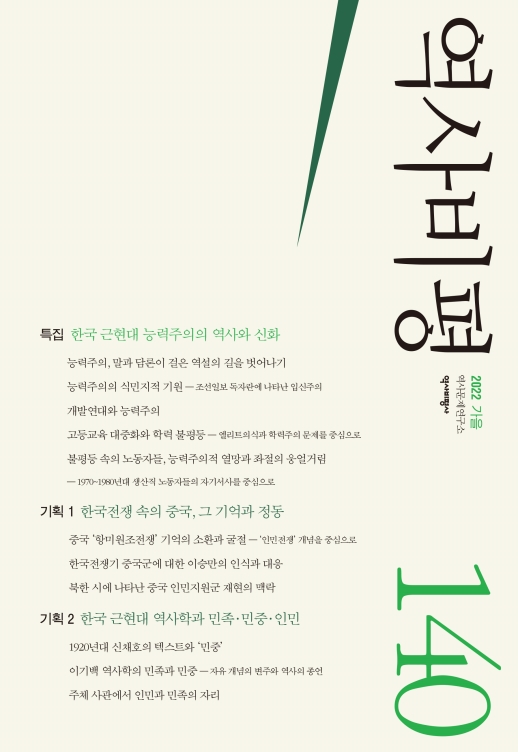
초록· 키워드
The deepening of inequality has made fairness and competence a hot topic instead of equality. Meritocracy appears in various forms under certain historical conditions. The effects and roles are bound to be different depending on the situation. Nevertheless, if the thickness of the time of meritocracy is measured, it is the largest in modern capitalism or capitalist modernity. The market for freedom, equality, and infinite competition created by the capitalist modern era is the best condition for meritocracy to flourish.
Meritocracy is not simply limited to abstract ideology. It is a value, a custom, and a series of institutional practices. In other words, meritocracy is systematically structured through education and operates as a principle of corporate management, and it spreads to the dominant value system and common sense through the public debate and permeates into everyday customs. Despite the categorical order of free and equal human beings, the social reproduction process naturally internalizes the hierarchy by ability.
The 1960s and 1970s are often referred to as the political and economic origins of modern Korea. This indicates that the width and depth of the change caused by capitalist industrialization were large. If the sense of material goods, equality and inequality, and ability that we are experiencing today is historically composed, it is clear that it cannot be irrelevant to the history of Korean capitalism. The task of asking what meritocracy developed in this era, commonly referred to as the “development era” is the key to understanding contemporary Korean society.
상세정보 수정요청해당 페이지 내 제목·저자·목차·페이지Meritocracy is not simply limited to abstract ideology. It is a value, a custom, and a series of institutional practices. In other words, meritocracy is systematically structured through education and operates as a principle of corporate management, and it spreads to the dominant value system and common sense through the public debate and permeates into everyday customs. Despite the categorical order of free and equal human beings, the social reproduction process naturally internalizes the hierarchy by ability.
The 1960s and 1970s are often referred to as the political and economic origins of modern Korea. This indicates that the width and depth of the change caused by capitalist industrialization were large. If the sense of material goods, equality and inequality, and ability that we are experiencing today is historically composed, it is clear that it cannot be irrelevant to the history of Korean capitalism. The task of asking what meritocracy developed in this era, commonly referred to as the “development era” is the key to understanding contemporary Korean society.
정보가 잘못된 경우 알려주세요!
목차
- 1. 머리말
- 2. 능력주의의 사회적 확산
- 3. 지능과 능력
- 4. 공론장의 능력주의와 비판 담론
- 5. 맺음말
- 참고문헌
참고문헌
참고문헌 신청최근 본 자료









UCI(KEPA) : I410-ECN-0101-2022-905-001699361