인문학
사회과학
자연과학
공학
의약학
농수해양학
예술체육학
복합학
 DBpia AI
 AI 에이전트
 AI 아이디어
 AI 리더
 AI 뷰어
 Citeasy
크롬 서지관리 다운로드
지원사업
학술연구/단체지원/교육 등 연구자 활동을 지속하도록 DBpia가 지원하고 있어요.
커뮤니티
연구자들이 자신의 연구와 전문성을 널리 알리고, 새로운 협력의 기회를 만들 수 있는 네트워킹 공간이에요.
초록·키워드
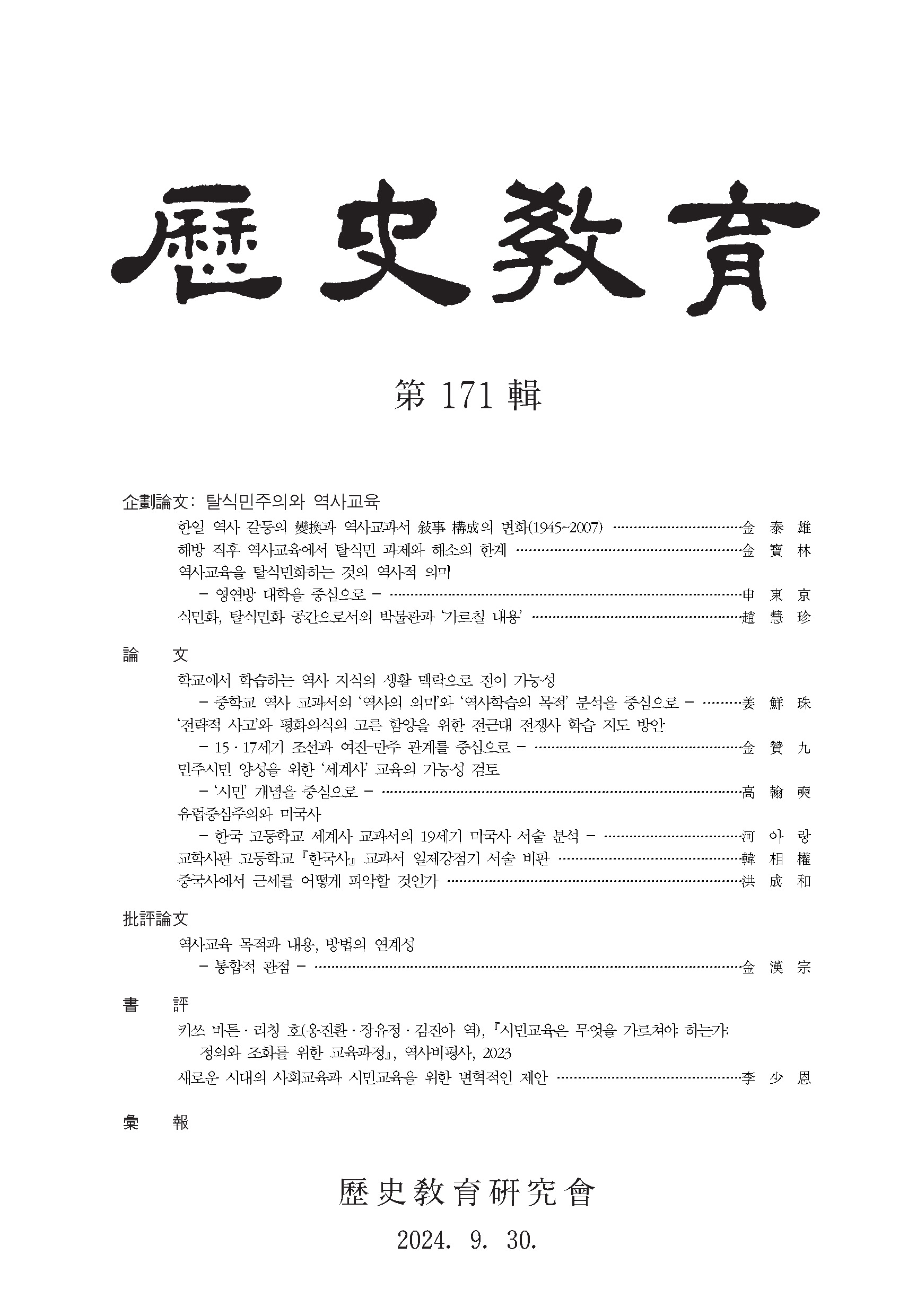
This paper summarizes the existing research on ‘the early modern’ and presents my own views based on it. It can be said that the discussions of Wallerstein, Frank, and Pomerantz show some consistent flow, although their issues are different. Their discussions are common in that they view the global economy after the 16th century as a center of a trade network between multiple countries rather than a one-country history, and that the difference in development between Europe and China does not result in the nature of each society, but rather in its position in the trade network, that is, an external factor. It was found that Europe’s dominance was gradually very accidental as the times went back.
Konan Naito and Ichisada Miyazaki defined the period from the Song Dynasty to before the Opium War as ‘the early modern’. Accordingly, new suggestions were made on the definition of ‘the early modern’ from the 1990s. Mio Kishimoto defined Chinese society with high liquidity as the ‘the early modern’ after it was incorporated into the silver economy in the 16th century until the Opium War. Hiroshi Miyajima argues that the Neo-Confucianism established in a small-farm society has ‘confucian modernity.’
This paper classifies the period from the early Song dynasty to the mid-Ming dynasty as “the earlier early modern,” and from the mid-Ming dynasty to the Opium War as “the later early modern, ” with an aim to clarify the characteristics of each. The earlier early modern was centered on trade with East and Southeast Asia, and the later early modern era was a period when trade with the West began in earnest.The stronger the liquidity, the greater the unity of civil society for survival, and the state power had no choice but to neglect it. However, when the Qing emperor had strong authority, integration was possible, but the Revolution of 1911 made this impossible.
This self-reform was impossible in the modern era, and eventually became the object of overthrow by Mao Zedong, and disappeared after 1949. Again, after 1949, it can be said that modern Chinese history began with the question of how to control excessive liquidity in the later early modern period.
본문·목차


인공지능 문자 인식 모델을 통해 추출된 텍스트로, 일부 오타나 오류가 포함될 수 있으나 지속적으로 개선 중입니다.
오류를 발견하셨다면 해당 부분을 드래그한 후 ' 를 통해 신고해주세요.
오류를 발견하셨다면 해당 부분을 드래그한 후 ' 를 통해 신고해주세요.
최근 본 자료 전체보기




UCI(KEPA) : I410-151-25-02-090936789

