인문학
사회과학
자연과학
공학
의약학
농수해양학
예술체육학
복합학
 DBpia AI
 AI 에이전트
 AI 아이디어
 AI 리더
 AI 뷰어
 Citeasy
크롬 서지관리 다운로드
지원사업
학술연구/단체지원/교육 등 연구자 활동을 지속하도록 DBpia가 지원하고 있어요.
커뮤니티
연구자들이 자신의 연구와 전문성을 널리 알리고, 새로운 협력의 기회를 만들 수 있는 네트워킹 공간이에요.
초록·키워드
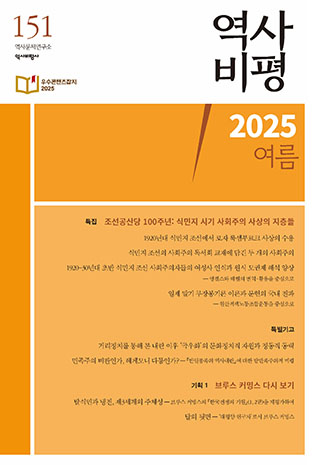
This paper case-studies the reading lists of thirty socialist reading groups in colonial Korea from the late 1920s to the early 1930s. It finds that the reading groups of peasants and workers, on the one hand, read Yamakawa Hitoshi’s Shihonshugi no Karakuri (The Mechanism of Capitalism) and Sakai Toshihiko’s Shakaishugi Taii (An Outline of Socialism) as their main texts, while the groups of vanguard youth and revolutionary mass movement, on the other, read the Communist Youth International’s Musansha Seiji Kyōtei (Political Program for the Proletariat). In peasants and workers’ readings, socialism was understood as the socialization of production and property under Marxist principles, which was to be achieved by proletarian class struggle. In contrast, the vanguard youth’s textbooks emphasized Leninism, identified socialism as being materialized by the Soviet Union, and demanded a communist party-led Korean and world revolution following the Soviet and Comintern’s lead. Witnessing the coexistence of these two schools, the paper suggests that the socialism did not progress linearly from Marxism to Leninism, and that it had a hierarchy within itself.
본문·목차


인공지능 문자 인식 모델을 통해 추출된 텍스트로, 일부 오타나 오류가 포함될 수 있으나 지속적으로 개선 중입니다.
오류를 발견하셨다면 해당 부분을 드래그한 후 ' 를 통해 신고해주세요.
오류를 발견하셨다면 해당 부분을 드래그한 후 ' 를 통해 신고해주세요.
최근 본 자료 전체보기





UCI(KEPA) : I410-151-25-02-093086124

