인문학
사회과학
자연과학
공학
의약학
농수해양학
예술체육학
복합학
 DBpia AI
 AI 에이전트
 AI 아이디어
 AI 리더
 AI 뷰어
 Citeasy
크롬 서지관리 다운로드
지원사업
학술연구/단체지원/교육 등 연구자 활동을 지속하도록 DBpia가 지원하고 있어요.
커뮤니티
연구자들이 자신의 연구와 전문성을 널리 알리고, 새로운 협력의 기회를 만들 수 있는 네트워킹 공간이에요.
피인용 0
초록·키워드
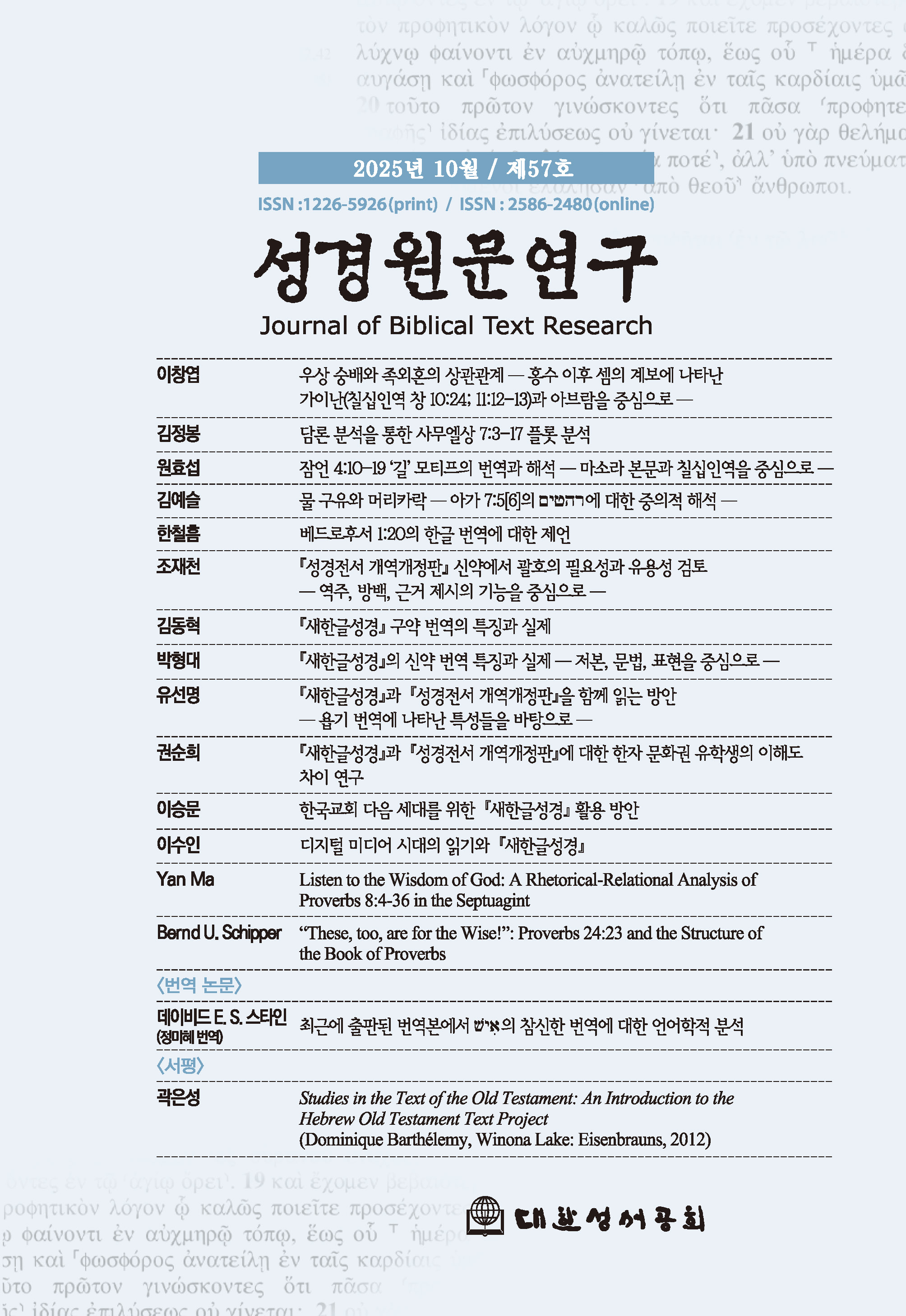
This study examines the main characteristics of the Old Testament translation in the New Korean Translation (『새한글』). Published in December 2024, this translation is a significant and welcome gift for those who want to read the Bible in Korean, arriving 31 years after the Protestant New Korean Standard Version (1993) and 19 years after the Korean Catholic Bible (2005). The study highlights three features: (1) the use of inversion, (2) the marking of speech types and addressees, and (3) the use of diverse honorific speech levels.
First, the study considers the use of inversion in light of the distinctive word order between Biblical Hebrew and Korean. Biblical Hebrew typically follows a VO (verb–object) structure, whereas Korean follows an OV (object–verb) structure, often resulting in the flow of thought running in opposite directions. Unlike previous Korean translations that primarily adhered to natural Korean word order, the New Korean Translation boldly adopts the word order of the original by employing inversion where possible. While this inverted structure may impede reading fluency, it encourages readers to engage more deliberately with the text, allowing them to deeply experience the original’s unique rhythm and thought flow. This feature is particularly noticeable in poetic and conversational passages.
Second, the Korean language avoids second-person pronouns when addressing someone of higher status, preferring honorific titles such as “God”, “Lord”, “Teacher”, “Mother”, “Father”, and “King”. This linguistic convention can create ambiguity in Korean Bible translations, making it unclear whether a phrase containing terms like ‘God’ or ‘Lord’ is a soliloquy or a prayer (e.g., Psa 23). The New Korean Translation resolves this ambiguity by explicitly inserting markers for speech types and addressees directly into the text (e.g., “(soliloquy)”, “(prayer)”). This innovative approach helps readers clearly grasp the speaker’s perspective and the target of their speech, thereby significantly enhancing comprehension.
Third, the New Korean Translation employs a much broader array of honorific speech levels than earlier versions, a feature with exegetical significance. For instance, in prophetic texts, where God’s words and the prophet’s words are frequently quoted, the New Korean Translation uses different honorific levels to distinguish them. It renders the prophet’s first-person speech in honorific language, while third-person references to the prophet are translated in plain language. In the book of Jeremiah, specifically, this distinction enables readers to easily discern first-person material likely originating with the prophet himself (using honorifics) versus later third-person additions (using plain language), thus supporting the understanding and application of modern critical biblical scholarship.
본문·목차


인공지능 문자 인식 모델을 통해 추출된 텍스트로, 일부 오타나 오류가 포함될 수 있으나 지속적으로 개선 중입니다.
오류를 발견하셨다면 해당 부분을 드래그한 후 ' 를 통해 신고해주세요.
오류를 발견하셨다면 해당 부분을 드래그한 후 ' 를 통해 신고해주세요.
최근 본 자료 전체보기




UCI(KEPA) : I410-151-26-02-094537018

