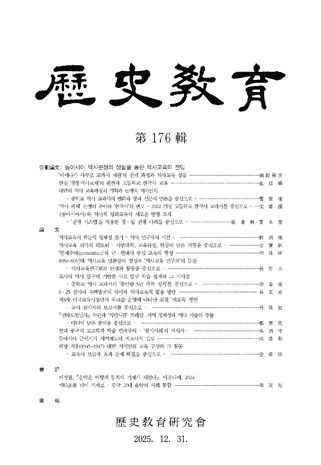
‘국사 해체’ 논쟁의 추이와 ‘한국사’의 변모 - 2022 개정 고등학교 한국사 교과서를 중심으로 -The Trend of the “Dismantling of National History” Debate and the Transformation of “Korean History” - Focusing on the 2022 Revised High School Korean History Textbook -
This study analyzed the development of debates on the “Dismantling of National History” since the 2000s and the changes in narrative in the 2022 revised Korean history textbooks. The debate on the “Dismantling of National History,” initially triggered by historical disputes with Japan and China, provided an opportunity to reflect on the limitations of nationalist historical narratives in Korea and to explore alternative approaches. Subsequently, discussions on nationalism continued amid contrasting criticisms from pseudo-history scholars and the New Right. In particular, the 2015 state-issued textbook controversy sparked criticism against the imposition of a uniform historical perspective and prompted the academic field of history education to seek new alternatives. In this process, the need for “democratic citizenship education” as a countermeasure to nation-centered historical perspective was emphasized, alongside calls to incorporate diverse identities, including gender, region, multiculturalism, and ethnicity, into historical education. The 2022 revised Korean history curriculum reflects these perspectives by avoiding national-centered narratives and emphasizing intercultural history and the diversity of historical interpretation. The eight textbooks developed under this curriculum generally maintain nationalist narratives regarding key historical events, such as the founding of Gojoseon, the unification of the Three Kingdoms by Silla, the March 1st Movement, liberation, and the Korean Special Investigation Committee of Anti-national Activities and the Law on the Punishment of Anti-national Activities. At the same time, they attempt to challenge the uniform nationalist framework by including multiple perspectives, local history, women’s history, multicultural narratives, and the history of everyday life. Therefore, the 2022 revised textbooks can be assessed as adopting a mosaic-like structure, combining dominant nationalist narratives with diverse perspectives.