인문학
사회과학
자연과학
공학
의약학
농수해양학
예술체육학
복합학
 DBpia AI
 AI 에이전트
 AI 아이디어
 AI 리더
AI 리더
 AI 뷰어
AI 뷰어
 Citeasy
크롬 서지관리 다운로드
Citeasy
크롬 서지관리 다운로드
지원사업
학술연구/단체지원/교육 등 연구자 활동을 지속하도록 DBpia가 지원하고 있어요.
커뮤니티
연구자들이 자신의 연구와 전문성을 널리 알리고, 새로운 협력의 기회를 만들 수 있는 네트워킹 공간이에요.
피인용 0
초록·키워드
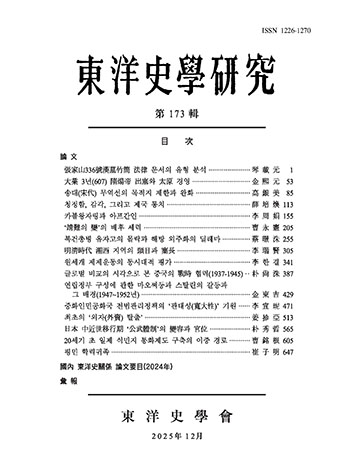
This study examines the structural problems inherent in the operation of maritime security along the Fujian coast in the late Ming dynasty through the activities and eventual downfall of Yu Zigao (兪咨皐), the Fujian regional commander-in-chief. It conceptualizes these problems as a “dilemma of outsourced maritime defense.” The term “outsourced maritime defense” does not imply that the Ming state deliberately adopted outsourcing as a formal policy. Rather, it serves as an analytical device to capture the historical process through which maritime defense increasingly took on the characteristics of outsourcing as a result of the repeated use of the strategy known as “using pirates to suppress pirates” (yong zei gong zei 用賊攻賊).
From the late sixteenth century onward, the Ming empire persistently relied on the incorporation of pirate forces into its military apparatus in response to growing maritime security threats under conditions of fiscal and military constraint. Contemporary sources referred to this approach as yi zei gong zei (以賊攻賊) or yong zei gong zei. While this strategy often proved effective in the short term, this study argues that it contained an inherent structural dilemma: once control over incorporated pirate forces weakened, the entire maritime defense system was exposed to systemic instability.
After assuming office as Vice Commander of the Southern Fujian Route in 1623 (Tianqi 3), Yu Zigao played a central role in directing the Penghu campaign. Through informal negotiations mediated by the merchant Li Dan (李旦) and the broker Xu Xinsu (許心素), he successfully compelled the Dutch East India Company (VOC) to withdraw from Penghu. Following his promotion to Fujian Commander-in-Chief, Yu continued to rely on unofficial networks involving the VOC and Chinese smugglers and pirate groups to maintain maritime security. The incorporation of the Yang Liu (楊六) group was widely regarded as a major success of this approach.
However, from 1627 onward, large-scale offensives launched by the Zheng Zhilong (鄭芝龍) group led to the rapid collapse of Yu Zigao’s system. This collapse was not merely the result of military failure but rather the manifestation of structural vulnerabilities inherent in a maritime defense regime heavily dependent on collaboration with pirate forces. In moments of crisis, incorporated pirate groups failed to fulfill their expected roles, while informal negotiations and transactional security arrangements exacerbated, rather than mitigated, systemic instability.
The Ming court’s subsequent decision to rely once again on the incorporation of Zheng Zhilong’s forces demonstrates that the dilemma of outsourced maritime defense was not the consequence of an individual commander’s misconduct or incompetence. Instead, it was a repeatedly reproduced outcome arising from the structural constraints faced by the late Ming maritime security system. Through this case, the present study reexamines the structural vulnerabilities of Ming maritime defense and the limitations that emerged from them.
From the late sixteenth century onward, the Ming empire persistently relied on the incorporation of pirate forces into its military apparatus in response to growing maritime security threats under conditions of fiscal and military constraint. Contemporary sources referred to this approach as yi zei gong zei (以賊攻賊) or yong zei gong zei. While this strategy often proved effective in the short term, this study argues that it contained an inherent structural dilemma: once control over incorporated pirate forces weakened, the entire maritime defense system was exposed to systemic instability.
After assuming office as Vice Commander of the Southern Fujian Route in 1623 (Tianqi 3), Yu Zigao played a central role in directing the Penghu campaign. Through informal negotiations mediated by the merchant Li Dan (李旦) and the broker Xu Xinsu (許心素), he successfully compelled the Dutch East India Company (VOC) to withdraw from Penghu. Following his promotion to Fujian Commander-in-Chief, Yu continued to rely on unofficial networks involving the VOC and Chinese smugglers and pirate groups to maintain maritime security. The incorporation of the Yang Liu (楊六) group was widely regarded as a major success of this approach.
However, from 1627 onward, large-scale offensives launched by the Zheng Zhilong (鄭芝龍) group led to the rapid collapse of Yu Zigao’s system. This collapse was not merely the result of military failure but rather the manifestation of structural vulnerabilities inherent in a maritime defense regime heavily dependent on collaboration with pirate forces. In moments of crisis, incorporated pirate groups failed to fulfill their expected roles, while informal negotiations and transactional security arrangements exacerbated, rather than mitigated, systemic instability.
The Ming court’s subsequent decision to rely once again on the incorporation of Zheng Zhilong’s forces demonstrates that the dilemma of outsourced maritime defense was not the consequence of an individual commander’s misconduct or incompetence. Instead, it was a repeatedly reproduced outcome arising from the structural constraints faced by the late Ming maritime security system. Through this case, the present study reexamines the structural vulnerabilities of Ming maritime defense and the limitations that emerged from them.
본문·목차


인공지능 문자 인식 모델을 통해 추출된 텍스트로, 일부 오타나 오류가 포함될 수 있으나 지속적으로 개선 중입니다.
오류를 발견하셨다면 해당 부분을 드래그한 후 ' 를 통해 신고해주세요.
오류를 발견하셨다면 해당 부분을 드래그한 후 ' 를 통해 신고해주세요.
최근 본 자료 전체보기




UCI(KEPA) : I410-151-26-02-096054012

