인문학
사회과학
자연과학
공학
의약학
농수해양학
예술체육학
복합학
 DBpia AI
 AI 에이전트
 AI 아이디어
 AI 리더
 AI 뷰어
 Citeasy
크롬 서지관리 다운로드
지원사업
학술연구/단체지원/교육 등 연구자 활동을 지속하도록 DBpia가 지원하고 있어요.
커뮤니티
연구자들이 자신의 연구와 전문성을 널리 알리고, 새로운 협력의 기회를 만들 수 있는 네트워킹 공간이에요.
피인용 0
초록·키워드
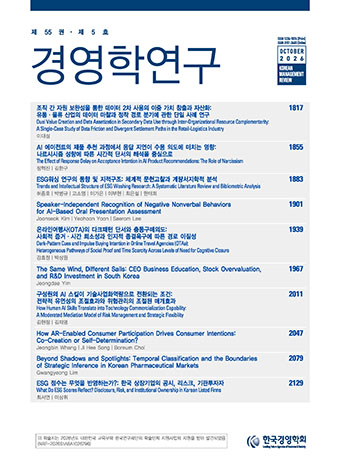
This study examines how stock overvaluation changes the relation between CEO business educational background and R&D investment. CEO business education may improve capital allocation and financing decisions, but it may also increase caution toward uncertain long-horizon projects such as R&D. Using a sample of Korean listed firms from 2011 to 2023, we find that business-educated CEOs are associated with lower R&D investment when firms are not overvalued, whereas they are associated with higher R&D investment when firms are overvalued. This result supports a reversal hypothesis rather than an amplification or mitigation hypothesis. The finding is robust to dynamic panel estimation, instrumental variable estimation, propensity score matching, alternative R&D measures, alternative overvaluation definitions, positive-R&D sample restrictions, and industry-by-year fixed effects. Mechanism tests show that the positive association between CEO business education and R&D investment among overvalued firms is concentrated among firms with short-horizon investors, regardless of financial constraint status. These findings are difficult to reconcile with a pure equity-financing explanation and are more consistent with a catering-based interpretation. Further tests show that the reversal pattern does not differ significantly by CEO ownership status or Chaebol affiliation. Overall, this study shows that CEO business education does not have a fixed implication for R&D investment. Its effect depends on valuation conditions, and the evidence suggests that the R&D response of business-educated CEOs under overvaluation is more consistent with catering incentives than with financing opportunities alone.
본문·목차


인공지능 문자 인식 모델을 통해 추출된 텍스트로, 일부 오타나 오류가 포함될 수 있으나 지속적으로 개선 중입니다.
오류를 발견하셨다면 해당 부분을 드래그한 후 ' 를 통해 신고해주세요.
오류를 발견하셨다면 해당 부분을 드래그한 후 ' 를 통해 신고해주세요.
최근 본 자료 전체보기







