인문학
사회과학
자연과학
공학
의약학
농수해양학
예술체육학
복합학
 DBpia AI
 AI 에이전트
 AI 아이디어
 AI 리더
 AI 뷰어
 Citeasy
크롬 서지관리 다운로드
지원사업
학술연구/단체지원/교육 등 연구자 활동을 지속하도록 DBpia가 지원하고 있어요.
커뮤니티
연구자들이 자신의 연구와 전문성을 널리 알리고, 새로운 협력의 기회를 만들 수 있는 네트워킹 공간이에요.
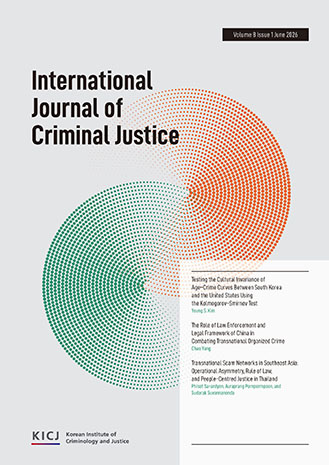
Transnational Scam Networks in Southeast Asia: Operational Asymmetry, Rule of Law, and People-Centred Justice in Thailand
논문 기본 정보
- 저자정보
- 저널정보
- 한국형사법무정책연구원 International Journal of Criminal Justice International Journal of Criminal Justice Vol.8 Issue.1
- 발행연도
- 2026.6
- 수록면
- 37 - 70 (34page)
피인용 0
Transnational Scam Networks in Southeast Asia: Operational Asymmetry, Rule of Law, and People-Centred Justice in Thailand
초록·키워드
This manuscript examines Thailand’s dual position within the Mekong sub-region’s transnational scam ecosystem: as a domestic target of cyber-enabled fraud and as a regional facilitation node exposed to illicit financial, logistical, and governance risks. Using a qualitative, policy-oriented document-based thematic synthesis, it argues that contemporary scam operations are a form of cyber-enabled transnational organized crime that can combine online fraud, trafficking for forced criminality, industrial-scale money laundering, and concealment through corporate or identity-related arrangements. Thailand’s digital infrastructure, financial connectivity, transport networks, and cross-border mobility channels support legitimate development, but they may also be exploited by criminal networks to move victims, data, money, and illicit services across jurisdictions. Analytically, the manuscript advances a dual-position framework that separates evidence of domestic-target exposure from evidence of regional-facilitation exposure and links these dimensions to four practical forms of operational asymmetry: money movement, digital evidence exchange, victim identification, and cross-border cooperation. This distinction avoids treating Thailand either simply as a victim jurisdiction or broadly as a scam hub. The synthesis identifies a plausible mismatch between criminal adaptation and institutional response across these four functions; it does not directly measure comparative response times or establish causal effects. It concludes that Thailand’s response should move beyond fragmented enforcement toward a sequenced policy roadmap combining immediate victim protection and rapid financial intervention, medium-term operational and financial-intelligence cooperation, platform and corporate accountability, and long-term rule-of-law, beneficial-ownership, and anti-corruption reform. Transnational scam networks require sustained transnational organized collaboration grounded in people-centred justice.
본문·목차


인공지능 문자 인식 모델을 통해 추출된 텍스트로, 일부 오타나 오류가 포함될 수 있으나 지속적으로 개선 중입니다.
오류를 발견하셨다면 해당 부분을 드래그한 후 ' 를 통해 신고해주세요.
오류를 발견하셨다면 해당 부분을 드래그한 후 ' 를 통해 신고해주세요.
최근 본 자료 전체보기





