번역 버튼을 눌러보세요!
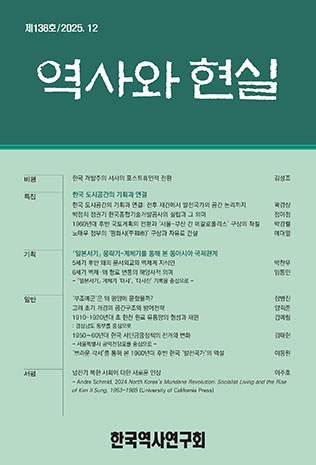
한국 개발주의 서사의 포스트휴먼적 전환 The Posthuman Turn in the Historical Narrative of South Korean Developmentalism
논문 기본 정보
- 저자정보
- 저널정보
- 한국역사연구회 역사와현실 역사와 현실 제138호
- 발행연도
- 2025.12
- 수록면
- 3 - 26 (24page)
- DOI
- 10.35865/YWH.2025.12.138.3
한국 개발주의 서사의 포스트휴먼적 전환
초록·키워드
The Park Chung Hee regime of the 1960s and 1970s is remembered as a pivotal turning point in modern Korean history and the period when Korean-style developmentalism took root within the Cold War capitalist order. Industrialization and economic growth, often mythologized as the ‘Miracle on the Han River,’ ‘rural modernization’ through the New Village Movement, and the establishment of an export-driven economic structure have been widely recognized as the core achievements of this era. The Developmental State Theory emerged as a useful analytical framework to explain this ‘success,’ and critical reflections on it have also steadily accumulated. These critiques generally pointed out the socioeconomic and political flaws of developmentalism or sought to correct the exclusion of peasants and the masses from the narrative.
While the critical discourse on developmentalism has offered important insights, it has also shared common limitations. It has not advanced to fundamentally question the very values of ‘growth and development’ inherent in developmentalism. The developmentalist ideology rests upon the Western tradition of anthropocentrism. This paper examines the critique of anthropocentrism within posthuman discourse precisely at this juncture. Posthumanism proposes a perspective where humans and non-human beings co-evolve within an interdependent network of relationships, becoming beings together. It demands a fundamental rethinking of the dualistic epistemology rooted in anthropocentrism. Viewing Korea’s developmentalist era through this lens reveals not a process determined solely by human design and will, but rather the unfolding of intertwined relationships between humans and nonhuman entities.
본문·목차
인공지능 문자 인식 모델을 통해 추출된 텍스트로, 일부 오타나 오류가 포함될 수 있으나 지속적으로 개선 중입니다.
오류를 발견하셨다면 해당 부분을 드래그한 후 ' 를 통해 신고해주세요.
최근 본 자료 전체보기
UCI(KEPA) : I410-151-26-02-095532044