인문학
사회과학
자연과학
공학
의약학
농수해양학
예술체육학
복합학
 DBpia AI
 AI agent
 AI idea
 AI reader
 AI Viewer
 Citeasy
Chrome Library Management Down
Citeasy
Chrome Library Management Down
Akaroot
DBpia provides support to continue researcher activities such as academic research/group support/education.
Community
It is a networking space where researchers can widely promote their work and expertise, and create opportunities for new collaborations.
Academic journal
Report ErrorsIf the title, authors, table of contents,or page range is incorrect, please let us know!
Basic article information
- Author
Citations 0
Abstract·Keywords
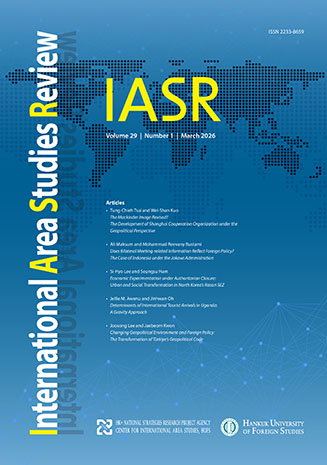
Bilateral meetings are often seen as indicative of a country’s foreign policy direction. This study investigates whether the frequency and content of President Joko Widodo ’s bilateral meetings align with Indonesia’s broader foreign policy agenda. Employing an information dissemination approach, the research analyses content from the State Secretariat of the Republic of Indonesia official website (https:// www.setneg.go.id), a relatively understudied source, using content analysis supported by NVivo. The findings reveal a disconnect between publicised diplomatic engagements and key policy narratives. While Jokowi frequently emphasises infrastructure development in public speeches, bilateral meetings are predominantly framed around commerce and industry. Additionally, Indonesia ’s most frequent meeting partners, such as Australia and Vietnam, differ from its key trade partners like China, the United States, and Japan. These discrepancies suggest that the state’s official communication does not fully reflect substantive foreign policy priorities. This study contributes a novel perspective to the study of Indonesian foreign policy by focusing on state-led information flows and issue mapping. It concludes with policy recommendations aimed at improving transparency and coherence in foreign policy communication.
Full text·Contents


Text extracted by AI character recognition may contain typos or errors but we're continuously improving.
If you find an error, drag the relevant text and click ' to report it.
If you find an error, drag the relevant text and click ' to report it.
Recently viewed View more




UCI(KEPA) : I410-151-26-02-096647624