인문학
사회과학
자연과학
공학
의약학
농수해양학
예술체육학
복합학
 DBpia AI
 AI 에이전트
 AI 아이디어
 AI 리더
 AI 뷰어
 Citeasy
크롬 서지관리 다운로드
개인구독
소속 기관이 없으신 경우, 개인 정기구독을 하시면 저렴하게
논문을 무제한 열람 이용할 수 있어요.
지원사업
학술연구/단체지원/교육 등 연구자 활동을 지속하도록 DBpia가 지원하고 있어요.
커뮤니티
연구자들이 자신의 연구와 전문성을 널리 알리고, 새로운 협력의 기회를 만들 수 있는 네트워킹 공간이에요.
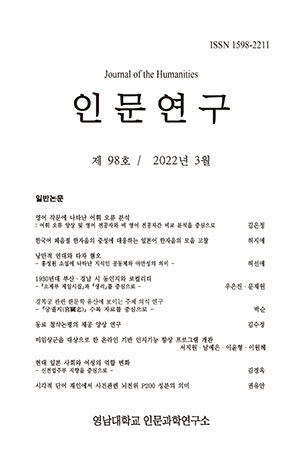
1930년대 부산·경남 시 동인지와 로컬리티 - 『소제부 제일시집』 과 『생리』를 중심으로 - Poetry Coterie Magazine of Busan·Gyeongnam Region and Locality during 1930s - Focusing on 『Sojebu』 and 『Saengli』 -
논문 기본 정보
- 저자정보
- 저널정보
- 영남대학교 인문과학연구소 인문연구 인문연구 제98호
- 발행연도
- 2022.3
- 수록면
- 87 - 134 (48page)
- DOI
- 10.21211/JHUM.98.4
피인용 0
1930년대 부산·경남 시 동인지와 로컬리티 - 『소제부 제일시집』 과 『생리』를 중심으로 -
초록·키워드
Literary coterie magazines, such as 『Chamsae』, 『Toseong(土聲)』, 『Sojebu (掃除夫)』 and 『Saengli(生理)』, were published in Busan and Gyeongsangnam-do from 1920s to 1930s. Their members were young lovers of literature who resided in the area of Busan or Gyeongnam and tried to create literary discourse and a local field for literature in those places. They were sharing humanistic locality of those days. In other words, they were sharing the temporality and placeness of Busan and Gyeongnam in 1920s and 1930s during the Japanese colonial era, and their experiences, understanding and discourse.
Among them, 『Sojebu(掃除夫)』 and 『Saengli(生理)』 were the literary coterie magazines published mainly by Yu Chi-hwan in 1930s. Its members were interacting through a Tongyeong youth club, 『Toseong(土聲)』, Busan student anti-Japanese movement and so on. The indirect resistance expressed through the early poems of Yu Chi-hwan and Jang Eung-du was not irrelevant to their exchange. In this thesis, the understanding of the reality in the literary works and the social activities of the members of 『Sojebu(掃除夫)』 and 『Saengli(生理)』 were analyzed together, and the locality and the meanings of the literary coterie magazines in Busan and Gyeongnam in 1930s were examined.
Among them, 『Sojebu(掃除夫)』 and 『Saengli(生理)』 were the literary coterie magazines published mainly by Yu Chi-hwan in 1930s. Its members were interacting through a Tongyeong youth club, 『Toseong(土聲)』, Busan student anti-Japanese movement and so on. The indirect resistance expressed through the early poems of Yu Chi-hwan and Jang Eung-du was not irrelevant to their exchange. In this thesis, the understanding of the reality in the literary works and the social activities of the members of 『Sojebu(掃除夫)』 and 『Saengli(生理)』 were analyzed together, and the locality and the meanings of the literary coterie magazines in Busan and Gyeongnam in 1930s were examined.
본문·목차


인공지능 문자 인식 모델을 통해 추출된 텍스트로, 일부 오타나 오류가 포함될 수 있으나 지속적으로 개선 중입니다.
오류를 발견하셨다면 해당 부분을 드래그한 후 ' 를 통해 신고해주세요.
오류를 발견하셨다면 해당 부분을 드래그한 후 ' 를 통해 신고해주세요.
최근 본 자료 전체보기




UCI(KEPA) : I410-ECN-0101-2022-001-001151816

