인문학
사회과학
자연과학
공학
의약학
농수해양학
예술체육학
복합학
 DBpia AI
 AI 에이전트
 AI 아이디어
 AI 리더
 AI 뷰어
 Citeasy
크롬 서지관리 다운로드
지원사업
학술연구/단체지원/교육 등 연구자 활동을 지속하도록 DBpia가 지원하고 있어요.
커뮤니티
연구자들이 자신의 연구와 전문성을 널리 알리고, 새로운 협력의 기회를 만들 수 있는 네트워킹 공간이에요.
피인용 0
초록·키워드
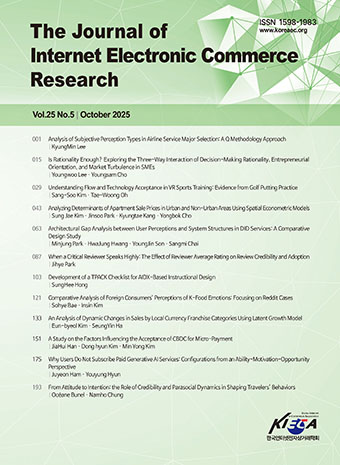
This study analyzes the determinants of apartment sale prices in Busan, South Korea, by applying spatial econometric models to distinguish between urban and non-urban areas. In the era of rapidly expanding digital real estate platforms, understanding localized price dynamics has direct implications for enhancing platform services such as market forecasting, valuation tools, and decision-support analytics. These platforms increasingly serve as the primary interface for buyers, sellers, and policymakers, yet most currently provide descriptive information and basic trend summaries rather than analytical insights into the structural drivers of housing prices. By incorporating spatial modeling results, platforms can move beyond simple listings to deliver advanced predictive functions, personalized valuation estimates, and neighborhood-level risk assessments. Using property and demographic variables such as exclusive area, floor level, year of construction, and local population density, the analysis confirms significant spatial autocorrelation, indicating clustering in apartment prices. Moran’s I statistic validates the non-random spatial distribution, supporting the use of spatial econometric approaches. To capture spatial dependence, three models are applied: the Spatial Lag Model (SLM), Spatial Error Model (SEM), and Spatial Durbin Model (SDM). The results show that while all models identify consistent effects of apartment characteristics and neighborhood population, the SDM provides the best fit and effectively captures both direct and spillover effects. These findings highlight that the determinants of apartment prices differ across urban and non-urban contexts, and they demonstrate how integrating spatial modeling insights into digital platforms can improve the accuracy of automated price estimations, provide more nuanced market intelligence, and support data-driven urban planning and housing policy.
본문·목차


인공지능 문자 인식 모델을 통해 추출된 텍스트로, 일부 오타나 오류가 포함될 수 있으나 지속적으로 개선 중입니다.
오류를 발견하셨다면 해당 부분을 드래그한 후 ' 를 통해 신고해주세요.
오류를 발견하셨다면 해당 부분을 드래그한 후 ' 를 통해 신고해주세요.
최근 본 자료 전체보기




UCI(KEPA) : I410-151-26-02-094516475

