인문학
사회과학
자연과학
공학
의약학
농수해양학
예술체육학
복합학
 DBpia AI
 AI 에이전트
 AI 아이디어
 AI 리더
AI 리더
 AI 뷰어
AI 뷰어
 Citeasy
크롬 서지관리 다운로드
Citeasy
크롬 서지관리 다운로드
지원사업
학술연구/단체지원/교육 등 연구자 활동을 지속하도록 DBpia가 지원하고 있어요.
커뮤니티
연구자들이 자신의 연구와 전문성을 널리 알리고, 새로운 협력의 기회를 만들 수 있는 네트워킹 공간이에요.
논문 기본 정보
- 자료유형
- 학술저널
- 저자정보
- 저널정보
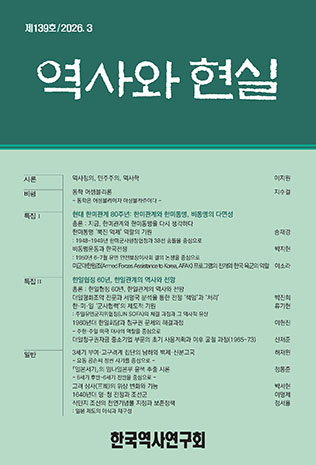
- 한국역사연구회 역사와현실 역사와 현실 제139호
- 발행연도
- 2026.3
- 수록면
- 405 - 454 (50page)
- DOI
- 10.35865/YWH.2026.3.139.405
이용수
초록· 키워드
Samsa(三司) of the Koryŏ dynasty functioned as a financial institution overseeing the central and local revenue, expenditure of grain and goods, and accounting. Although modeled on the Song(宋) dynasty system, it evolved within Koryŏ’s unique political and economic context. In the early Goryeo period, the Samsa installed a Pansa(判事) as its head, a position that didn’t exist in the Song, and they maintained close concurrent appointments with high-ranking officials such as Jae-chu(宰樞). Most Samsa posts were concurrent appointments without independent authority, operating alongside Hobu(⼾部) in a dual fiscal structure. Hobu managed land and population registers, while the Samsa was operated as a practical institution responsible for the expenditure of grain and goods. This system, while adopting the framework of the Song, operated within Koryŏ’s own distinctive bureaucratic and fiscal structure.
In the late Koryŏ period, the Samsa saw a simultaneous elevation in both its organizational structure and official ranks, leading to a significant enhancement of its institutional status. From the reign of King Chungnyŏl(忠烈王) onward, the Samsa underwent marked institutional transformation, with increases in personnel, specialization, and rank. High officials such as Pan-Samsa-sa(判三司 事) rose to the level of Jaesang(宰相), while lower posts came to be held as full-time appointments. By late Koryŏ, the establishment of Yeong-Samsa-sa(領 三司事) confirmed its standing as a leading central government organ rivaling Munha-bu(⾨下府).
So the institutional strengthening of the Samsa took place amid changes in the bureaucratic system and the reorganization of the political structure in the late Koryŏ. During the reign of King Chungnyŏl, while many government offices were downgraded accounting for that they resembled institutions of the Yuan(元) dynasty, the Samsa, being an institution that didn’t exist in Yuan, was free from such constraints. Moreover, the existing structure and operation mode of the Samsa were well suited to the needs of an expanded bureaucratic society. As a result, it came to absorb the Sangseo-seong(尙書省) and established itself as an office possessing Jaesang. Such reforms not only suited to broader changes in the bureaucratic system but also functioned as an institutional institution for the long-term preservation and utilization of Koryŏ’s distinctive administrative framework.
Meanwhile, as the bureaucratic system expanded organizationally, emphasis was placed on establishing mechanisms to provide economic compensation to officials for the work they performed. This situation, overlapping with the crisis of Jeonsigwa(⽥柴科) system after the 12th century, led to the increasing importance of the Samsa, primarily responsible for expenditures, within the constraints of its coexistence with the Hobu, which had oversaw land. Accordingly, from the late Koryŏ to the early Chosŏn period, it functioned as a principal office in land reform and, in political terms, came to form one of the Three Offices alongside the Munha-bu(⾨下府) and the Miljik-sa(密直司).
In this way, the enhancement of the Samsa’s status and functions resulted from Koryŏ’s effort to adaptively utilize its own institutions in response to changing social conditions.
In the late Koryŏ period, the Samsa saw a simultaneous elevation in both its organizational structure and official ranks, leading to a significant enhancement of its institutional status. From the reign of King Chungnyŏl(忠烈王) onward, the Samsa underwent marked institutional transformation, with increases in personnel, specialization, and rank. High officials such as Pan-Samsa-sa(判三司 事) rose to the level of Jaesang(宰相), while lower posts came to be held as full-time appointments. By late Koryŏ, the establishment of Yeong-Samsa-sa(領 三司事) confirmed its standing as a leading central government organ rivaling Munha-bu(⾨下府).
So the institutional strengthening of the Samsa took place amid changes in the bureaucratic system and the reorganization of the political structure in the late Koryŏ. During the reign of King Chungnyŏl, while many government offices were downgraded accounting for that they resembled institutions of the Yuan(元) dynasty, the Samsa, being an institution that didn’t exist in Yuan, was free from such constraints. Moreover, the existing structure and operation mode of the Samsa were well suited to the needs of an expanded bureaucratic society. As a result, it came to absorb the Sangseo-seong(尙書省) and established itself as an office possessing Jaesang. Such reforms not only suited to broader changes in the bureaucratic system but also functioned as an institutional institution for the long-term preservation and utilization of Koryŏ’s distinctive administrative framework.
Meanwhile, as the bureaucratic system expanded organizationally, emphasis was placed on establishing mechanisms to provide economic compensation to officials for the work they performed. This situation, overlapping with the crisis of Jeonsigwa(⽥柴科) system after the 12th century, led to the increasing importance of the Samsa, primarily responsible for expenditures, within the constraints of its coexistence with the Hobu, which had oversaw land. Accordingly, from the late Koryŏ to the early Chosŏn period, it functioned as a principal office in land reform and, in political terms, came to form one of the Three Offices alongside the Munha-bu(⾨下府) and the Miljik-sa(密直司).
In this way, the enhancement of the Samsa’s status and functions resulted from Koryŏ’s effort to adaptively utilize its own institutions in response to changing social conditions.
#고려
#삼사
#호부
#충렬왕
#전시과
#녹봉
#재정 운영
#관료제
#Koryŏ (高麗)
#Samsa (三司)
#Hobu (戶部)
#King Chungnyŏl (忠烈王)
#Jeonsigwa (田柴科)
#Salary system
#Financial management
#Bureaucracy
상세정보 수정요청해당 페이지 내 제목·저자·목차·페이지정보가 잘못된 경우 알려주세요!
목차
- 머리말
- 1. 고려 삼사의 제도적 전개와 위상 변화
- 2. 고려후기 정치 ∙ 경제적 변화와 삼사의 강화
- 맺음말
- 참고문헌
- Abstract
참고문헌
참고문헌 신청최근 본 자료