인문학
사회과학
자연과학
공학
의약학
농수해양학
예술체육학
복합학
 DBpia AI
 AI 에이전트
 AI 아이디어
 AI 리더
 AI 뷰어
 Citeasy
크롬 서지관리 다운로드
지원사업
학술연구/단체지원/교육 등 연구자 활동을 지속하도록 DBpia가 지원하고 있어요.
커뮤니티
연구자들이 자신의 연구와 전문성을 널리 알리고, 새로운 협력의 기회를 만들 수 있는 네트워킹 공간이에요.
피인용 0
초록·키워드
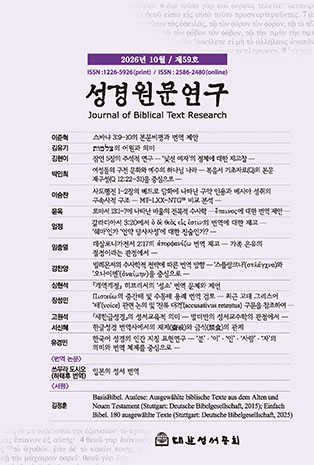
This article reconsiders the translation of ἀπορφανίζω in 1 Thessalonians 2:17 in light of the family metaphor developed throughout 1 Thessalonians 2. Although the verb fundamentally means “to make an orphan” or “to become orphaned,” most English and Korean Bible translations render it simply as “to be separated” or “to leave,” thereby overlooking its metaphorical force. Lexical evidence, classical Greek usage, and major lexicons consistently indicate that ἀπορφανίζω denotes the experience of orphanhood rather than mere separation. Nevertheless, modern translations have generally emphasized the result of separation instead of the emotional and relational implications conveyed by the original expression.
This study argues that the meaning of ἀπορφανίζω cannot be adequately explained on lexical grounds alone but must be interpreted within the literary context of Paul's family metaphors in 1 Thessalonians 2. To support this argument, the study examines the lexical evidence, the use of ἀπορφανίζω in classical Greek, and the literary development of Paul's family metaphors throughout the chapter. Paul successively portrays himself as an infant (2:7b), a nursing mother (2:7c), and a father (2:11-12), presenting his apostolic ministry through intimate family imagery rather than apostolic authority. Building on these metaphors, this article contends that ἀπορφανίζω represents the rhetorical climax of the family metaphor, depicting Paul himself as one who has become “orphaned” from the Thessalonian believers. This interpretation also explains why Paul deliberately chose ἀπορφανίζω instead of the more common verb χωρίζω, which he elsewhere employs to describe separation. By selecting this rare verb, Paul expresses not merely physical absence but the profound emotional loss resulting from the temporary disruption of familial bonds.
Accordingly, this article proposes that the translation of ἀπορφανίζω should preserve the metaphor of orphanhood rather than reduce it to the idea of separation alone. Such a rendering more faithfully reflects both the lexical meaning of the verb and its rhetorical function within the broader family imagery of 1 Thessalonians 2. In doing so, this study contributes to a more coherent understanding of Paul's family metaphors and offers a fresh perspective on the translation and interpretation of 1 Thessalonians 2:17.
본문·목차


인공지능 문자 인식 모델을 통해 추출된 텍스트로, 일부 오타나 오류가 포함될 수 있으나 지속적으로 개선 중입니다.
오류를 발견하셨다면 해당 부분을 드래그한 후 ' 를 통해 신고해주세요.
오류를 발견하셨다면 해당 부분을 드래그한 후 ' 를 통해 신고해주세요.
최근 본 자료 전체보기







