인문학
사회과학
자연과학
공학
의약학
농수해양학
예술체육학
복합학
 DBpia AI
 AI 에이전트
 AI 아이디어
 AI 리더
 AI 뷰어
 Citeasy
크롬 서지관리 다운로드
지원사업
학술연구/단체지원/교육 등 연구자 활동을 지속하도록 DBpia가 지원하고 있어요.
커뮤니티
연구자들이 자신의 연구와 전문성을 널리 알리고, 새로운 협력의 기회를 만들 수 있는 네트워킹 공간이에요.
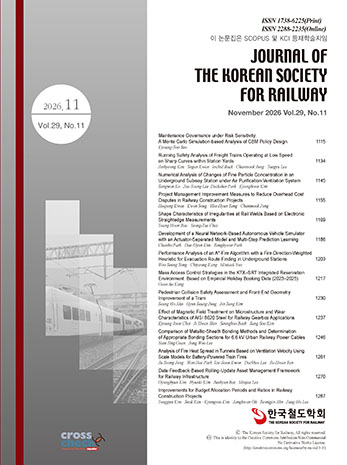
Maintenance Governance under Risk Sensitivity: A Monte Carlo Simulation-based Analysis of CBM Policy Design
논문 기본 정보
- 저자정보
- 발행연도
- 2026.11
- 수록면
- 1,115 - 1,133 (19page)
- DOI
- 10.7782/JKSR.2026.29.11.1115
피인용 0
Maintenance Governance under Risk Sensitivity: A Monte Carlo Simulation-based Analysis of CBM Policy Design
초록·키워드
Maintenance decision-making in complex infrastructure systems is inherently conducted under uncertainty due to stochastic degradation processes and imperfect condition observations. Although Condition-Based Maintenance (CBM) has been widely adopted to improve maintenance efficiency, many implementations still rely on fixed decision thresholds that do not explicitly reflect organizational risk preferences. Consequently, maintenance policies often remain weakly connected to strategic maintenance governance. This study proposes a risk-sensitive maintenance framework that integrates stochastic degradation dynamics, failure penalties, and organizational risk sensitivity within a unified decision structure. A Monte Carlo simulation environment is developed to analyze system behavior under uncertain degradation and to evaluate maintenance policies using a Risk-Weighted Availability (RWA) metric. The results demonstrate that the optimal CBM threshold varies systematically with the level of risk sensitivity. As the penalty associated with failure increases, maintenance interventions occur earlier, leading to more conservative maintenance strategies. The analysis further reveals a structured policy landscape in which the relative performances of CBM and Time-Based Maintenance (TBM) change across different risk regimes. More importantly, the results reveal that the optimal intervention threshold is an endogenous function of organizational risk sensitivity, θ*(λ). As risk sensitivity increases, the optimal threshold decreases systematically, triggering earlier preventive maintenance actions and progressively shifting maintenance governance toward more conservative policies. These findings demonstrate that maintenance thresholds should be interpreted as strategic governance variables rather than fixed engineering parameters, thereby providing a theoretical bridge between stochastic condition monitoring and risk-sensitive maintenance governance in complex railway systems.
본문·목차


인공지능 문자 인식 모델을 통해 추출된 텍스트로, 일부 오타나 오류가 포함될 수 있으나 지속적으로 개선 중입니다.
오류를 발견하셨다면 해당 부분을 드래그한 후 ' 를 통해 신고해주세요.
오류를 발견하셨다면 해당 부분을 드래그한 후 ' 를 통해 신고해주세요.
최근 본 자료 전체보기





